2012年1月29日 星期日

Therapeutic Hypothermia in Comatose Patients after Cardiac Arrest

Targeted Temperature Management for Comatose Survivors of Cardiac Arrest
N Engl J Med 2010;363:1256-64.

Indications
  • Adult patients successfully resuscitated from a witnessed OHCA of presumed cardiac cause (patients after in-hospital cardiac arrest may also benefit)
  • Patients who are comatose (i.e., patients with GCS < 8 or patients who do not obey any verbal command at any time after ROSC and before initiation of cooling)
  • Patients with an initial rhythm of Vf or nonperfusing VT (patients presenting with other initial rhythms such as asystole or PEA may also benefit)
  • Patients whose condition is hemodynamically stable (retrospective data suggest that patients in cardiogenic shock may also safely undergo hypothermia treatment)

Contraindications
  • Patients with tympanic-membrane temperature below 30°C on admission
  • Patients who were comatose before the cardiac arrest
  • Pregnant patients
  • Patients who are terminally ill or for whom intensive care does not seem to be appropriate
  • Patients with inherited blood coagulation disorders
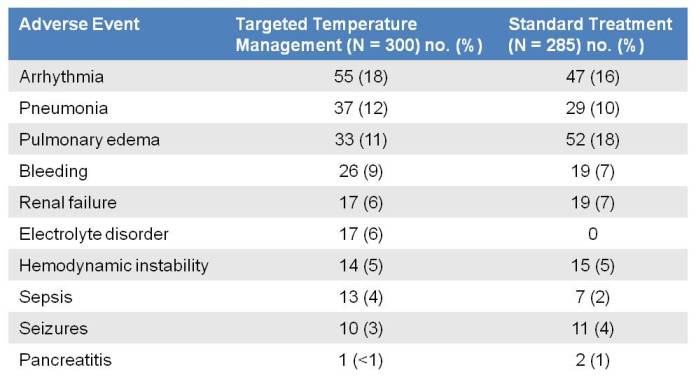
    Adverse Events 

    相關文章:Post–Cardiac Arrest Care

    2012年1月21日 星期六

    How to Interpret Elevated Cardiac Troponin Levels

    How to Interpret Elevated Cardiac Troponin Levels
    Circulation 2011;124:2350-2354.

    Evolution of the cardiac troponin assays and their diagnostic cutoffs

    The 99th Percentile Rule
    In the presence of a clinical history suggestive of ACS, the following is considered indicative of myocardial necrosis consistent with myocardial infarction: maximal concentration of cTn exceeding the 99th percentile of values for a reference control group on at least one occasion during the first 24 hours after the clinical event.


    Causes of Elevated Plasma cTn Other Than ACS
    Cardiac Causes
    • Cardiac contusion resulting from trauma
    • Cardiac surgery
    • Cardioversion
    • Endomyocardial biopsy
    • Acute and chronic heart failure
    • Aortic dissection
    • Aortic valve disease
    • Hypertrophic cardiomyopathy
    • Tachyarrhythmia
    • Bradyarrhythmia, heart block
    • Apical ballooning syndrome
    • Post–PCI
    • Rhabdomyolysis with myocyte necrosis
    • Myocarditis or endocarditis/pericarditis
    Noncardiac Causes
    • Pulmonary embolism
    • Severe pulmonary hypertension
    • Renal failure
    • Stroke, SAH
    • Infiltrative diseases, eg, amyloidosis
    • Cardiotoxic drugs
    • Critical illness
    • Sepsis
    • Extensive burns
    • Extreme exertion

    Serial Troponin Testing
    Collecting a second specimen for cTn testing within 2 to 3 hours from the collection of the blood sample at presentation to help confirm the diagnosis of MI.

    Troponin kinetics in the index cases

    2012年1月16日 星期一

    資訊圖表 Infographics


    一張好的圖表勝過千言萬語

    資訊圖表 (Information graphics or infographics) 是將複雜的資訊、資料或知識,用視覺化的圖表,清楚快速的呈現方式。

    簡單的說,就是將繁複的數據或抽象的概念轉化為圖像,方便讀者快速掌握龐雜的訊息。


    資訊圖表的組成元素
    1. 解讀訊息 (Interpreting information graphics):要傳達給讀者什麼樣的訊息

    2. 數據資料 (Elements of information graphics):資訊圖表所要呈現的資料、訊息或知識

    3. 視覺元素 (Visual devices):地圖、統計圖表、表格、流程圖.....

    參考資料:
    維基百科 Information graphics


    資訊圖表範例網站:
    GOOD Infographics
    Cool Infographics
    VizWorld
    visual.ly

    2012年1月4日 星期三

    Damage Control Resuscitation

    Damage Control Resuscitation:
    The New Face of Damage Control

    J. trauma Volume 69(4), October 2010, pp 976-990

    “Damage control” for severely injured patients to provide only interventions necessary to control hemorrhage and contamination to focus on reestablishing a survivable physiologic status.

    Topics include DCR: surgery, transfusion ratios, permissive hypotension, recombinant factor VIIa (rFVIIa), hypertonic fluid solutions, and the lethal triad of hypothermia, acidosis, and coagulopathy.

    PERMISSIVE HYPOTENSION

    Keep the blood pressure low enough to avoid exsanguination while maintaining perfusion of end organs.
    Trauma patients without definitive hemorrhage control should have a limited increase in blood pressure until definitive surgical control of bleeding can be achieved.

    ISOTONIC CRYSTALLOIDS

    • dilutional coagulopathy
    • hypothermia
    • hyperchloremic acidosis 

    HYPERTONIC SALINE

    HTS attractive for its ability to raise blood pressure quickly at much lower volumes of infusion than isotonic fluids and, thus, potentially easier to use and transport into combat.
    Risks and concerns associated with HSD:
    • Uncontrolled bleeding
    • Hyperchloremic acidosis
    • Central pontine myelinolysis

    COMPONENTS OF COAGULOPATHY

     1. Hypothermia

    ER: resuscitation period
    OR: exposure of the peritoneum
    2.  Acidosis
    3.  Coagulopathy: More than 5 units of pRBC will lead to a dilutional coagulopathy

    Early Identification of Shock

    • altered mental status, cool/clammy skin, and an absent radial pulse 
    • shock index (SI= HR/SBP)
    • bicarbonate, base deficit, and lactate
    • ABC (assessment of blood consumption) scoring:
    1. Penetrating mechanism
    2. Positive FAST
    3. SBP ≦ 90 mmHg on arrival
    4. Heart rate ≧120 bpm on arrival
    Score ≧ 2 is 75% sensitive and 86% specific for predicting massive transfusion

    A Blood- and Coagulation Factor-Based Resuscitation Strategy

    The optimal ratio of FFP to PRBC was 1:1 and that this should be given early in the course.

    Resuscitation With Blood

    Fresh whole blood transfusion is currently primarily limited to the most severely injured military combat casualties.

    Recombinant Factor VIIA

    • for all trauma: off-label use!
    • rFVIIa seems to be safe and possibly decreases transfusion in blunt trauma.
    • rFVIIa has not shown any efficacy in penetrating trauma.

    DAMAGE CONTROL SURGERY

    Three Phase:
    1. Initial operation with hemostasis and packing
    2. Transport to the ICU to correct the conditions of hypothermia, acidosis, and coagulopathy
    3. Return to the OR for definitive repair of all temporized injuries